Why Your Makeup Survives the Class and Fails on the Cold Walk Home
Quick Answer: Makeup fails on the walk home because of a sequence: your skin is warm and damp, your pores and oil production are elevated from the session, and then cool air causes rapid moisture condensation and contraction on the surface. Product that was holding on a stable warm surface slides on a rapidly cooling damp one. The fix is a two-minute post-class step - blot rather than wipe, let the skin cool indoors for a few minutes, then add a thin fresh layer only where needed.
You checked in the studio mirror on the way out and everything was fine.
Eight minutes later on the street your foundation was patchy, your mascara had migrated and you had no idea when it happened.

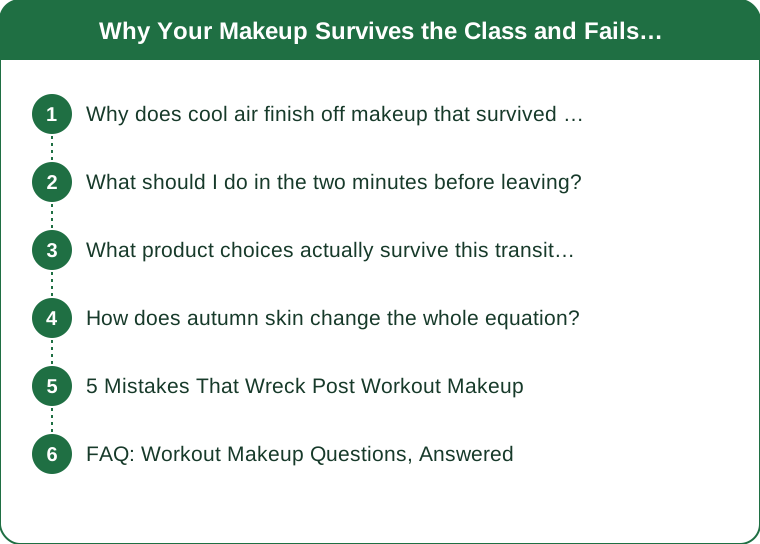
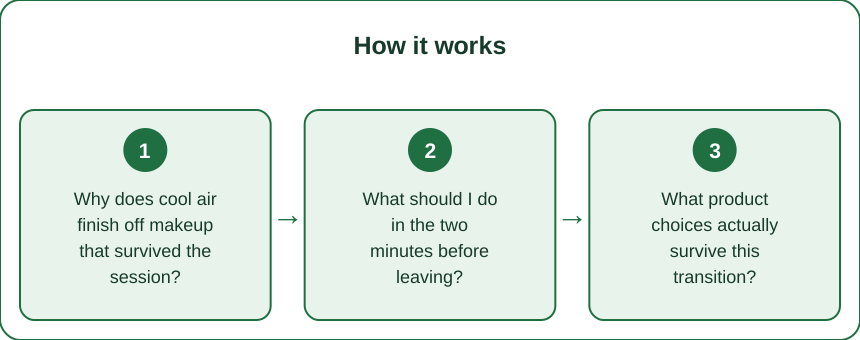
Why does cool air finish off makeup that survived the session?
Your skin is warm, damp and producing more oil at the end of a class, which is the least stable surface any product will sit on all day.
Moving into cool air causes rapid surface cooling, and moisture condenses on skin that was evaporating a moment earlier.
That combination of oil, residual sweat and condensation is what breaks the film that foundation and concealer form.
Contraction plays a part too. Skin and product cool at different rates, and the mismatch produces the patchiness and settling into lines that appears within minutes.
Eye area products migrate most, because the skin there is thin, the area is warmest and there is more movement from blinking in cold air.
And wind accelerates every part of this, which is why the same walk on a still day is much kinder.
What should I do in the two minutes before leaving?
Blot, do not wipe. Pressing a tissue or blotting paper removes surface oil and moisture without dragging product off, which wiping does immediately.
Let your skin cool indoors for three to five minutes before going out, which is the single most effective step and the one everyone skips.
Cool the face gently with a cold splash or a cool cloth if the venue allows, since bringing skin temperature down before you go outside removes the sudden shift.
Then add a very thin layer only where needed, typically under the eyes and across the nose, rather than reapplying everything.
Set lightly with powder in the T-zone only, which controls the areas that will produce oil for the next hour without making the whole face look flat.
And put the layer on before you step outside, not after, since applying product to cold skin on the street gives an uneven result.
What product choices actually survive this transition?
Long-wear and transfer-resistant formulations genuinely perform better, particularly for base and brow, and this is one area where the marketing claim maps onto real behaviour.
Waterproof mascara is the highest-return single swap for anyone whose eye makeup migrates, though it needs a proper remover.
Cream and gel products for cheek colour outlast powder on damp warm skin, since powder needs a dry stable surface to hold.
Lighter coverage survives better than heavy coverage, because a thick layer has more to move and shows patchiness more obviously when it does.
A hydrating base matters in autumn specifically, since cool dry air dehydrates the surface and dehydrated skin makes any product look patchy.
And SPF still belongs in the routine, since a clear autumn day can carry a UV index high enough to matter. This is general information, not medical advice.

How does autumn skin change the whole equation?
Cool dry air pulls moisture from the skin surface, which is the main seasonal change and the reason a summer routine looks worse in October on the same face.
Dehydrated skin produces more oil in some people, which makes base products slide more rather than less.
Indoor heating compounds it, and studios and offices both get dry the moment heating comes on.
Barrier disruption becomes more common, showing up as tightness, flaking and product not sitting well - which is a skincare problem being blamed on makeup.
Add hydration before adding coverage. A more hydrating moisturiser under the same makeup often solves what looks like a product failure.
And post-workout cleansing matters more, since sweat, product and a compromised barrier together is a combination worth managing carefully. Ask a qualified professional if you have persistent skin concerns. This is general information, not medical advice.
5 Mistakes That Wreck Post Workout Makeup
1. Wiping instead of blotting. Wiping removes product and moves what remains into an uneven layer. Pressing a tissue against the skin removes the oil and leaves the base intact, and it takes the same amount of time.
2. Reapplying immediately while still hot. Product applied to warm damp skin will not set and will slide within minutes. Three to five minutes of cooling before touching anything changes the result entirely.
3. Reapplying everything rather than the two areas that failed. Full reapplication over existing product builds a thick layer that looks heavier and fails faster. Under the eyes and across the nose is usually the whole job.
4. Using the same base you use for the office. A light hydrating everyday base is not built for a warm damp surface. If you go straight from class to somewhere that matters, a transfer-resistant formulation is the piece to change.
5. Ignoring hydration in autumn. People respond to autumn patchiness by adding more coverage, which is precisely backwards. Dehydrated skin needs moisture underneath, and the coverage problem usually resolves on its own.
And the bonus: skipping the cleanse because you will shower later. Sweat plus product plus several hours is the combination most likely to cause congestion. A quick cleanse at the studio costs a minute. This is general information, not medical advice.
FAQ: Workout Makeup Questions, Answered
Should I wear makeup to exercise at all?
It is a personal choice. Lighter, non-comedogenic products and a prompt cleanse afterwards are the usual practical recommendations if you prefer to. Speak to a qualified professional if you have specific skin concerns.
Why does everything fail specifically on the walk home?
Warm damp skin meeting cool air produces condensation and rapid temperature change, which breaks the film that base products form. It is the transition, not the exercise.
Is waterproof mascara worth it?
For most people whose eye makeup migrates, it is the single most effective change. Use an appropriate remover, since scrubbing at the eye area is worse than the smudging was.
Cream or powder blush after a workout?
Cream, generally. Powder needs a dry stable surface, which post-workout skin is not, and it tends to look patchy on damp skin.
How long should I wait before reapplying?
Three to five minutes indoors is usually enough for skin temperature to come down. Applying while warm is the most common reason reapplication fails within the hour.
Does autumn air change what I should use?
Yes - hydration underneath matters more as air gets cooler and drier, and adding coverage instead of moisture is the usual mistake.
Should I cleanse at the gym or wait until home?
Cleansing sooner is generally preferable to leaving sweat and product on the skin for hours. A gentle cleanse or micellar step at the venue is a reasonable compromise. This is general information, not medical advice.
TL;DR:
- Warm damp skin meeting cool air is what breaks makeup, not the sweat during the session.
- Blot rather than wipe, then let your skin cool indoors for three to five minutes before touching anything.
- Reapply thinly under the eyes and across the nose only, and set the T-zone lightly.
- Cream products and transfer-resistant bases outperform powder on post-workout skin.
- Autumn patchiness is usually dehydration - add moisture underneath rather than more coverage.
Fix the transition, not the product. This is general information, not medical advice.
Keep Reading
This article is for general informational and styling purposes only. Fit, sizing, and product availability may vary.