Why Sunscreen and Sweatproof Makeup Fight Each Other
Quick Answer: Sunscreen forms a continuous film on the skin surface, which is exactly the surface long-wear makeup needs to grip. Layering them without a break means the makeup bonds to the sunscreen rather than to your skin, so both slide off together as soon as you sweat. Apply sunscreen, wait 10 to 15 minutes for it to set, then apply a minimal amount of long-wear product on top — and accept that the two goals genuinely compete.
You did the responsible thing. You put sunscreen on before your outdoor session.
Thirty minutes in, your makeup was in your eyebrows and your sunscreen was in your eyes.
Those two facts are the same fact.
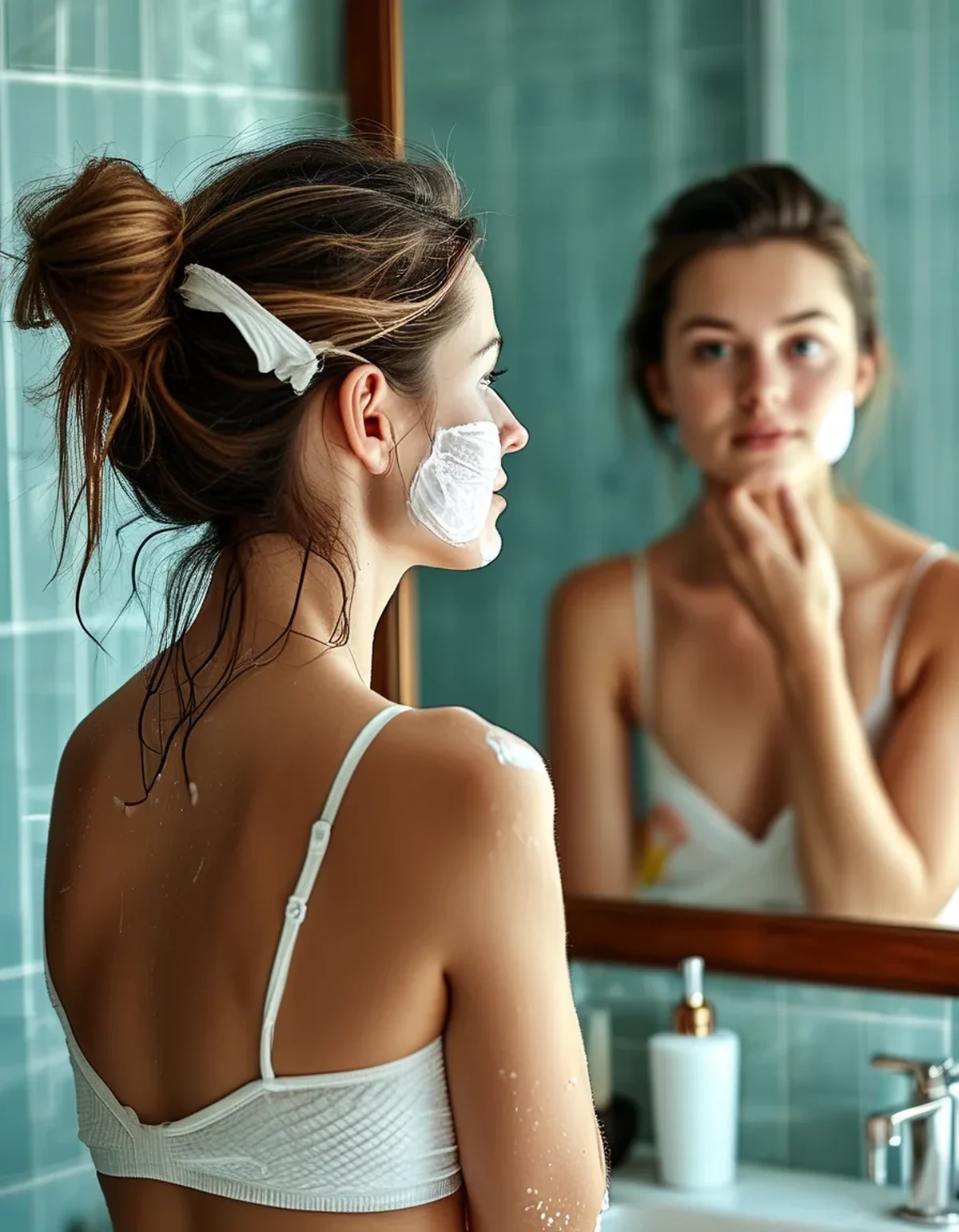
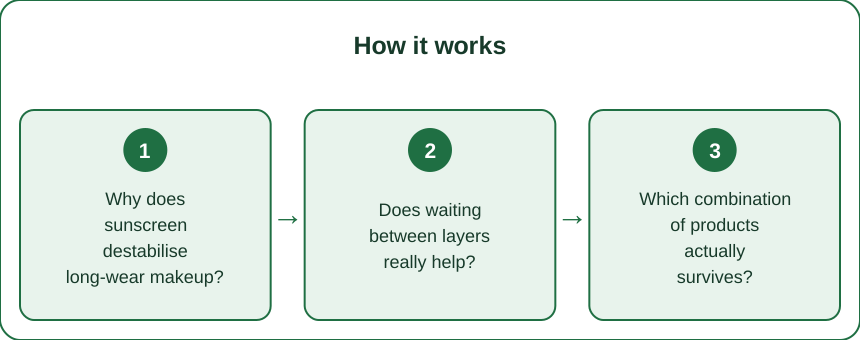
Why does sunscreen destabilise long-wear makeup?
Because of what sunscreen is designed to do, which is to remain as a uniform layer on top of the skin.
Modern sunscreens contain film formers — polymers whose job is to keep the UV filters evenly distributed and to resist being washed or rubbed away. That film is slightly flexible, often slightly tacky, and it sits between your skin and everything you apply afterwards.
Long-wear foundations and setting products rely on adhering to the skin surface and then setting into a flexible film of their own. When you put them on top of a sunscreen film that has not fully set, three things happen: adhesion is to the sunscreen rather than the skin, the two films can partially dissolve into each other, and the combined layer is thicker and heavier than either alone.
The result is a layer that moves as a unit. When sweat and sebum break the bond underneath, the whole thing shifts together — which is why the failure is so total. It is not that your makeup wore off gradually. It slid.
Does waiting between layers really help?
It is the single most effective change, and it is free.
Most sunscreens need 10 to 15 minutes to form a properly set, even film. Applying makeup at minute two means applying it into a wet layer, which guarantees mixing and pilling. Applying it at minute fifteen means applying it onto a set surface, which behaves far more like normal skin.
This is also why sunscreen labels advise applying 15 to 30 minutes before sun exposure. The waiting period is not only about absorption; it is about the film having time to form.
A practical routine: apply sunscreen as the last step of skincare, then do something else entirely — get dressed, pack your bag, make coffee — and come back to makeup afterwards. Building the wait into an existing gap in your morning is much more reliable than standing there counting.
The pilling test tells you whether you have waited long enough. If small rolls of product appear when you apply the next layer, the film underneath was not set.
Which combination of products actually survives?
The one with the fewest layers, applied thinly.
Sunscreen: for a sweaty outdoor session, a water-resistant formula is worth seeking out, and mineral filters based on zinc oxide tend to hold up slightly better under sweat than some chemical formulas. Whichever you choose, the quantity matters — roughly two finger-lengths for face and neck — and under-applying to make makeup behave defeats the purpose entirely.
On top, choose one: a long-wear tinted product or a setting spray, not a full routine. Every additional layer is another interface that can fail.
Skip: heavy primers with silicone, which frequently pill over sunscreen; powder foundations applied over an unset film; and anything described as dewy or hydrating for an outdoor session, since those formulas are designed to stay mobile.
Waterproof mascara and a good brow product are the two items that survive most reliably, and for many people they are the sensible minimum for outdoor training. This is the honest answer that product marketing avoids: the more you apply, the more there is to slide.
Myth vs Fact: Sunscreen Under Makeup
Myth: Makeup with SPF means you can skip sunscreen. Fact: The SPF in foundation is tested at an application thickness far greater than anyone actually uses. Realistically you get a fraction of the labelled protection. Treat it as a bonus, never as your primary protection.
Myth: Setting spray locks everything in place. Fact: Setting spray helps the top layer, but it cannot fix a weak bond several layers down. If the sunscreen was not set before the makeup went on, spray will not save it.
Myth: Mineral sunscreen always pills more. Fact: Pilling is driven by formulation and drying time more than by filter type. Plenty of mineral sunscreens layer beautifully; plenty of chemical ones pill. The wait matters more than the category.
Myth: Reapplying sunscreen over makeup is impossible. Fact: It is awkward but doable with a powder or stick sunscreen, pressed rather than rubbed. It is not equivalent to a full reapplication, but it is considerably better than nothing on a long outdoor day.
Myth: Sweatproof means it will survive anything. Fact: Water-resistant claims are tested for 40 or 80 minutes of immersion. Heavy sweating plus wiping your face with a towel defeats almost everything, because it is the mechanical rubbing rather than the moisture that does the damage.
What is the actual routine for a sweaty outdoor session?
Kept deliberately short, because complexity is the enemy here.
15 minutes before: clean skin, light moisturiser if you need it, then water-resistant sunscreen at full quantity. Then stop and do something else.
At the 15-minute mark: if you want it, one thin layer of long-wear tint or concealer only where you actually want it — usually not the full face. Waterproof mascara, brows, and nothing else.
Set lightly: a small amount of translucent powder pressed into the T-zone, or a setting spray. Not both.
During the session: blot, never wipe. Wiping with a towel removes the sunscreen film along with the sweat, which is both a protection failure and a makeup failure. Pressing a clean towel gently against the skin removes moisture and leaves the film largely intact.
After: cleanse properly. Water-resistant sunscreen and long-wear makeup both need an actual cleanser — often a double cleanse — rather than a face wipe. Product left on skin after a sweaty session is one of the more common causes of post-workout breakouts.
This is general information, not medical or dermatological advice. If you have persistent irritation or breakouts, see a qualified professional.
FAQ: Sunscreen and Makeup Questions, Answered
Should I just skip makeup for outdoor workouts?
It is the option that works best, and it is worth being honest that it is the option. If makeup matters to you, the minimal version — brows, waterproof mascara, targeted concealer — survives far better than a full face.
Why does my sunscreen sting my eyes when I sweat?
Most commonly because it has migrated with sweat from the forehead. A stick sunscreen along the hairline and brow area, which is less mobile than a lotion, plus a headband, solves most of it.
Can I put sunscreen on top of makeup instead?
It works less well, because you cannot achieve an even film over an existing layer. If you must, a powder sunscreen pressed on is the most practical option — but sunscreen first, makeup second, remains the better order.
TL;DR:
- Sunscreen forms a film that makeup grips instead of your skin, so both slide off together when you sweat.
- Wait 10 to 15 minutes after sunscreen before applying anything else — the single most effective fix available.
- Use fewer layers: water-resistant sunscreen, one thin long-wear product, waterproof mascara, and stop there.
- Blot, do not wipe, and cleanse properly afterwards to avoid post-workout breakouts.
The two products are both doing their jobs. They simply want the same square inch of skin, and only one of them can have it.
Keep Reading
This article is for general informational and styling purposes only. Fit, sizing, and product availability may vary.