Why How You Towel Your Face Decides How Long Your Makeup Lasts
Quick Answer: Wiping drags product off; blotting lifts moisture and leaves product behind. A dragging wipe across the forehead removes base, disturbs the film that is holding everything together, and creates the patchy zones that everything after that slides into. The whole fix is pressing straight down with a clean, dry, smooth-textured cloth — and doing it before sweat runs, not after.
You spent time on the base. You set it, you sprayed it, you used the products that are supposed to hold.
Forty minutes later your forehead is bare, your foundation has gathered at your jaw and your under-eyes are a mess.
Somewhere around minute twelve you wiped your face with a rough towel. That was the moment it ended.

Why does wiping do so much damage?
Because it applies lateral force to a layer that has almost no lateral strength.
Makeup on skin is a thin film — pigment, binders, powders and setting product bonded to the skin surface and to each other. That film is designed to resist water and to flex, but it has essentially no resistance to being dragged sideways.
A wipe does three things at once:
1. It removes product. Pigment transfers to the towel. This is the obvious part, and it is visible on the cloth afterward.
2. It thins unevenly. Wiping never removes uniformly. It leaves ridges and channels, so what remains is patchy rather than lighter. A patchy base is what everything else then slides into.
3. It disturbs the set layer. Setting spray and powder work by forming a stabilising layer over the base. Once that layer is broken in a spot, the base underneath is exposed and behaves as if it was never set.
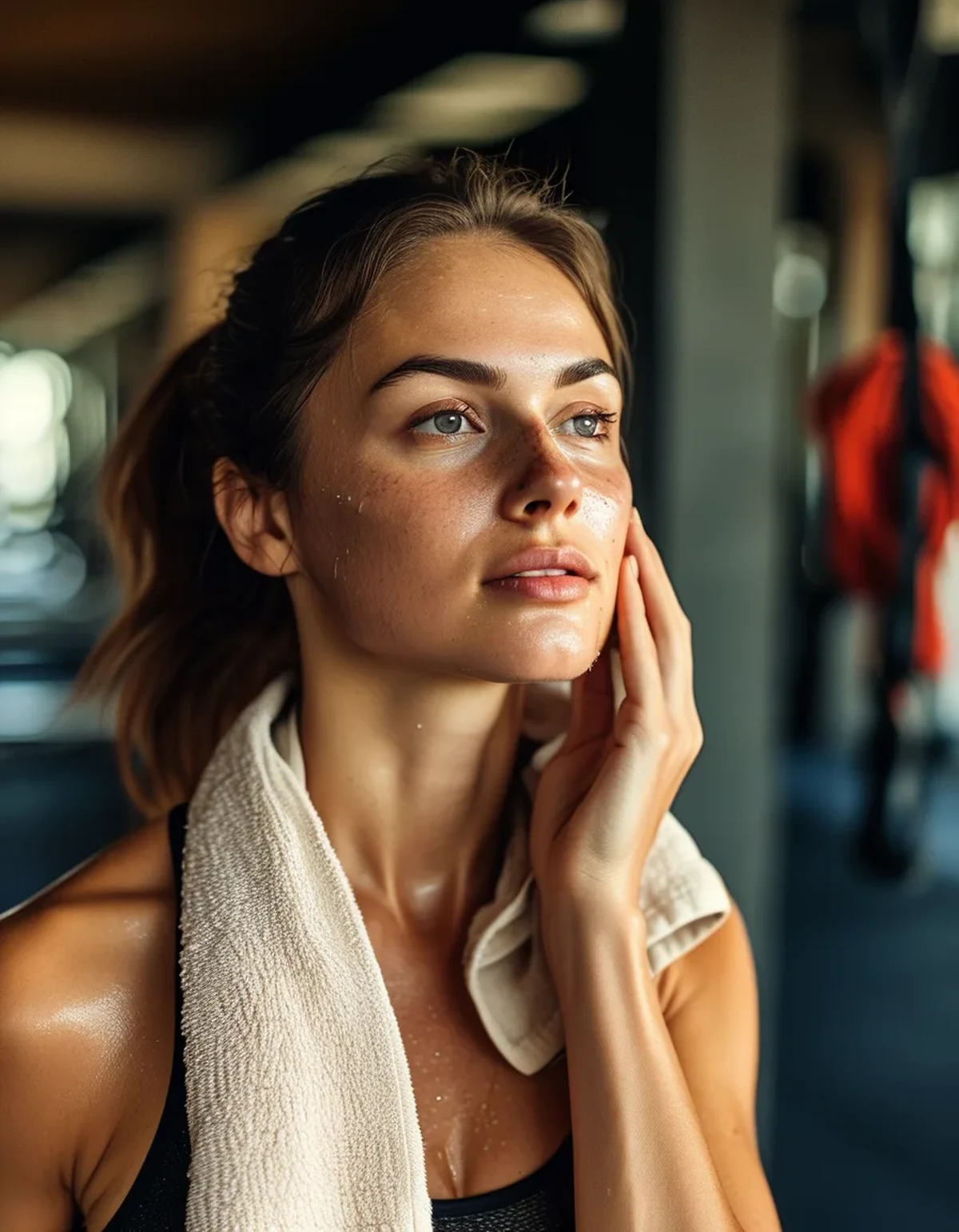
Blotting applies vertical force instead. Pressing straight down transfers moisture to the cloth by absorption, without shear. The film stays intact. Pigment mostly stays where it was.
The difference in result is far larger than the difference in effort, which is what makes this the highest-value habit change available.
What should you actually be blotting with?
Texture and dryness matter more than what the item is called.
What works well:
- A smooth microfibre cloth — small, flat weave, no loops. The best all-round option and easy to carry.
- Blotting papers. Purpose-made and excellent, but they saturate fast and you need several.
- A clean cotton handkerchief or flat-weave cloth. Smooth surface, absorbent, cheap.
- Your gym towel’s flattest section, if that is all you have — but see below.
What works poorly:
- Terry towelling with loops. The loops catch on the makeup film and drag even when you press rather than wipe. This is the standard gym towel and it is the worst common option.
- Anything already damp. A damp cloth cannot absorb, so pressing it just redistributes moisture and softens the product.
- Paper towels from the dispenser. Abrasive, and they shed fibres onto a tacky surface.
- Your hand or forearm. Guaranteed drag, plus transfer of skin oil.
The practical setup: a small dedicated cloth for your face, kept separate from your body towel and kept dry. It needs to be a different item, because the moment your face cloth is also your body towel, it is damp within ten minutes and useless.
Myth vs Fact: managing sweat during a workout
Myth: You should wait until you actually need to wipe. Fact: By the time sweat is running, it has already lifted product and is carrying it downward. Blot early and often — small amounts before it pools, rather than a big wipe when it becomes a problem.
Myth: Setting spray means you can wipe safely. Fact: Setting spray improves water resistance and film cohesion. It does nothing against mechanical shear. No product on the market resists being rubbed off.
Myth: Powder before a workout stops the sliding. Fact: Powder manages humidity and surface oil well, and sweat poorly. It also makes drag worse, because dragging a powdered surface picks up both powder and the base beneath it.
Myth: The forehead is the priority area. Fact: The forehead sweats first and most visibly, but the hairline and temples are where the damage compounds, because that is where sweat runs from and where people wipe hardest.
Myth: Blotting during a workout is fussy. Fact: It is two seconds, three or four times a session. The alternative is repairing everything afterward, which takes considerably longer and starts from a worse base.
When during the session does it matter most?
There are three specific moments, and they are not evenly spaced.
Minute 8-15 — the first sweat. This is the critical window. Your skin has warmed, the first moisture appears at the hairline and temples, and this is when most people wipe for the first time. A blot here, before it runs, prevents nearly all subsequent problems. A wipe here creates them.
The transition between exercises. Anything involving lying down, inverting, or putting your face near equipment transfers product. Blot before you lie down, not after — pressing your face into a bench after twenty minutes of sweat is how the jawline gathering happens.
The last five minutes and the cool-down. Sweat continues after you stop, often at a higher rate for several minutes. The end of the session is not the end of the sweating, and the cool-down blot is the one everyone skips.
And the one outside the session entirely: the walk home or the commute. Moving from a warm studio into cool air causes a rapid change — sweat continues briefly while the surface cools, and this is where the held in class, failed on the way home pattern comes from.
A practical rhythm: blot at 10 minutes, blot between blocks, blot at the end, blot again before you leave the building. Four times, two seconds each.
Does the season change the approach?
It is changing right now, and in a direction that catches people out.
Through humid late summer, the problem is ambient humidity as much as sweat. Sweat evaporates poorly, sits on the surface, and makeup fails from being permanently damp. Blotting is frequent and the cloth saturates quickly — carry two.
As the air dries and cools in early autumn, three things shift:
- Sweat evaporates faster, so there is less surface moisture during the session and blotting is needed less often.
- Studios get heated, which means the indoor-to-outdoor gap widens sharply — you finish hot in a warm room and step into genuinely cool air.
- Skin gets drier, which changes how base sits and often means a more emollient base, which is more vulnerable to drag, not less.
The result is a specific autumn failure pattern: less sweating during the session, so people blot less, but a more fragile base and a bigger temperature transition at the end. Makeup that survives the class fails between the door and the car.
The adjustment: keep blotting at the same frequency even though it feels less necessary, and add one blot after you have cooled down but before you go outside.
FAQ: Blotting and Workout Makeup, Answered
Can I fix a patch mid-workout?
Not well. Adding product onto damp, disturbed makeup rarely improves it and often makes the texture worse. Blot, leave it, and repair properly afterward on a stable surface.
Should I blot the under-eye area?
Yes, and very gently. It is the area with the thinnest skin and the most fragile product, and it is where mascara transfer shows fastest. Press, do not slide, and use a clean part of the cloth.
Does this apply to sunscreen too?
Exactly the same, and arguably more importantly — a wiped forehead is unprotected skin. If you are training outdoors, blot rather than wipe and reapply sunscreen afterward regardless.
TL;DR:
- Wiping applies shear force, which the makeup film has no resistance to. Blotting applies vertical pressure, which it handles fine.
- Use a small, smooth, dry cloth kept separate from your body towel — terry loops are the worst common option.
- Blot early, at the first sweat around minute 10, before anything runs.
- Blot again before lying down, at the end, and before stepping outside.
- Autumn’s drier air means less visible sweat but a more fragile base and a bigger temperature transition — keep the same blotting rhythm.
If you have been buying progressively more heavy-duty products and still losing your base by minute forty, change the cloth and the motion before you change anything else. It is free, it takes one session to test, and for most people it does more than any product swap they have tried.
Keep Reading
This article is for general informational and styling purposes only. Fit, sizing, and product availability may vary.