Why Setting Spray Works for Some Sweat and Not Others
Quick Answer: Setting sprays work by forming a thin polymer film over your makeup. That film resists water sitting on top of it, and it does not resist sebum, friction, or moisture pushing up from underneath — which is exactly what a workout produces. So a spray holds beautifully through a hot, still day and fails during exercise, because exercise adds oil and rubbing to the water.
It held through a four-hour outdoor event in August. It did not survive one HIIT class. Same spray, same face, completely different kind of sweat.
What does setting spray actually do?
It lays down a film, and that film only solves one of the three ways makeup comes off.
Most setting sprays are water or alcohol carrying a film-forming polymer — often an acrylate copolymer or something similar — plus humectants and sometimes silicones. When the carrier evaporates, the polymer is left as a continuous, flexible, very thin layer over your makeup.
That layer does two useful things. It physically binds loose powder and pigment in place, so nothing migrates or dusts off. And it repels water landing on the surface — rain, a splash, tears.
What it cannot do is much more relevant to a gym.
It does not stop sebum. Oil is produced under your makeup, by your skin, and it pushes upward. A film on top is on the wrong side of the problem. Sebum dissolves and mobilises the oils and pigments in foundation from beneath, and the film simply rides on top of the resulting slurry.
It does not survive friction. The film is microns thick and mechanically fragile. One pass of a towel, a sleeve, a strap, or your own hand takes it off in a strip, along with whatever it was holding down.
And it does not stop sweat from underneath. Sweat emerges from pores beneath your makeup. A surface film has no ability to stop that, and as it accumulates, it lifts the whole layer off the skin from below.
So: excellent against water landing on you, poor against oil, friction, and sweat rising through you. A workout is almost entirely the second category.
Why do different workouts break it differently?
Because they differ in the three variables the film cannot handle: oil, friction, and heat.
Steady-state cardio in a cool room is the easiest case. Sweat is mostly water, it evaporates, and there is little contact with your face. A good spray often survives 45 minutes of this intact.
Hot yoga and heated classes are close to the worst case. Sustained high skin temperature increases sebum output substantially, the humidity stops any evaporation, and downward-facing poses put your face against a mat and a towel. The failure here is mostly oil and mostly from underneath.
HIIT and spin combine high sweat rate with constant face-touching — wiping, adjusting, towelling. Friction is the primary destroyer here, and it is why the makeup fails in patches rather than evenly.
Strength training is intermediate: less total sweat, more forehead contact with bars and benches, plus the specific problem of straining, which flushes the face and raises local temperature.
Swimming is a special case and the one setting spray handles relatively well, because immersion is water on top — precisely the thing the film resists. What it does not resist is goggle friction and towel drying.
And outdoor autumn exercise brings the underrated combination: cool air on the outside and hard work underneath, so you sweat under a layer that then chills, and the temperature swing plus wind makes the film brittle in a way a warm room does not.
Which sprays hold up and which do not?
The distinction is between film-formers built for water resistance and mists built for finish.
Sprays that hold under exercise generally share these traits:
- A named long-wear or transfer-resistant claim, rather than a dewy, hydrating, or refreshing one
- A higher polymer content, which you can feel — it dries to a slightly tight, definite film rather than disappearing
- Alcohol as a carrier, which flashes off fast and leaves the film behind cleanly
- A matte or natural finish rather than a glow, because glow usually means added emollients that work against adhesion
Sprays that fail under exercise:
- Hydrating and dewy mists. These contain humectants and oils by design. Humectants attract water, which is the opposite of what you want when water is arriving from your own pores.
- Refreshing facial mists. These are not setting sprays at all and contain no meaningful film-former.
- Anything with a noticeable oil or ester content, which softens the makeup underneath rather than locking it.
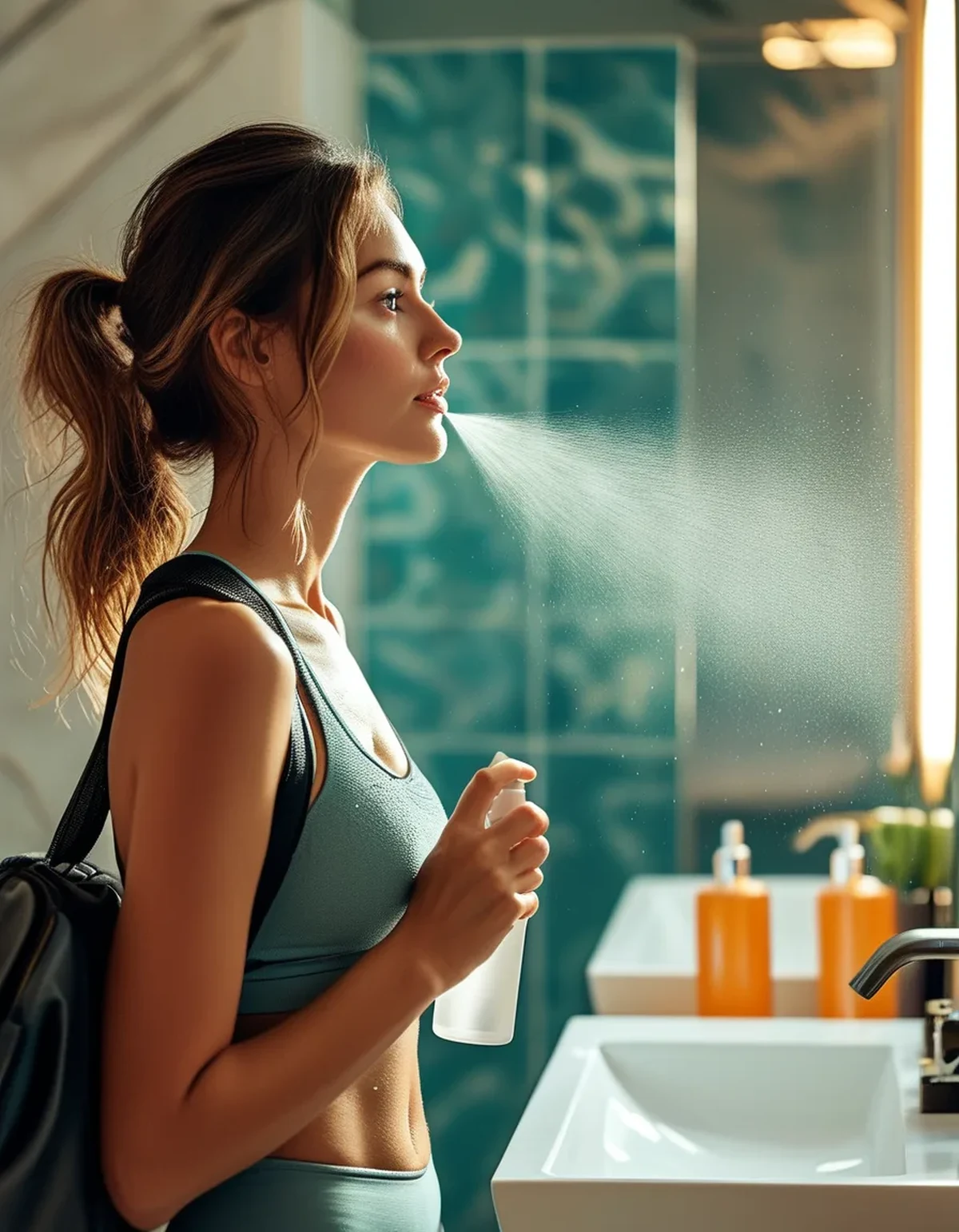
The application matters as much as the product. Hold it at arm’s length, mist in an X and then a T across the face, and let it dry undisturbed for a full minute. Do not fan it, do not blot it, and do not press a sponge into it. Touching it before it dries is the single most common way people negate it entirely.
Two thin passes with drying time between them outperform one heavy pass, which pools in creases and dries unevenly.
5 Mistakes That Make Setting Spray Fail Faster
1. Spraying over a heavy moisturiser or facial oil. The film needs something to grip. An emollient-rich base underneath keeps the whole stack mobile, and no amount of spray on top compensates. For workouts, a light gel moisturiser fully absorbed, or nothing at all in the T-zone, holds far better.
2. Skipping powder. Setting spray and setting powder do different jobs and they work best together — powder absorbs oil at the source, spray binds the surface. Sprayed makeup with no powder underneath has nothing controlling the sebum arriving from below, and the film just floats on it.
3. Using it as the whole strategy. Spray is the last 10% of longevity, not the first 60%. That comes from the formulas underneath: a gripping primer, a genuinely long-wear or water-resistant foundation, cream products set with powder. A spray over the wrong base is a fence on sand.
4. Wiping instead of blotting. Every wipe removes the film in a stripe. Blotting paper or a clean towel pressed straight on and lifted off takes the sweat and leaves most of the makeup. Two seconds of technique, and it is the highest-value habit on this list.
5. Re-spraying over a wet face mid-workout. Applying more spray onto sweat gives the polymer nothing to bond to and often produces a visible patchy film. Blot completely dry first, or wait until after. If you are re-setting between a workout and going somewhere, dry, blot, powder, then spray.
What actually works for a workout face?
A different structure, with the spray in its correct supporting role.
Decide first how much face you need. The most reliable answer for hard training is genuinely less: skin prep, brows, lash tint or waterproof mascara, and a cheek tint survives anything, and it removes the failure mode entirely. Everything below is for when you want more than that.
The build that holds:
- Clean, dry, minimal base. Light gel moisturiser, absorbed for five minutes. Skip oils and rich creams.
- A gripping or mattifying primer in the T-zone only — this is the layer doing the real adhesion work.
- A long-wear or water-resistant foundation or tinted sunscreen, applied thin. Thin is the whole trick; thick layers slide as a sheet.
- Cream products before powder, powder over the top to set. Powder blush over cream blush lasts dramatically longer than either alone.
- Waterproof formulas at the eyes, without exception. Tubing mascara and a waterproof pencil outlast everything else you own.
- Setting powder in the oil zones — forehead, nose, chin, and under the eyes if anything migrates there.
- Setting spray last, two light passes, full drying time.
Then plan for the failure you will still have. Bring blotting papers, not a towel, for your face. Bring a waterproof pencil for one repair. Expect the T-zone and under-eye to go first and be relaxed about it.
Timing helps more than product. Makeup applied 20 to 30 minutes before you start holds noticeably better than makeup applied five minutes before, because the films need time to set fully.
Seasonal note: as indoor classes get warmer and less ventilated through autumn while outdoor air gets colder and drier, most people find they need more oil control indoors and more hydration underneath outdoors — which is why a routine that worked all summer stops working around now.
FAQ: Setting Spray and Sweat, Answered
Is setting spray or setting powder better for working out?
Powder, if you have to choose, because it absorbs oil at the source and oil is the main destroyer during exercise. They work best as a pair — powder to control sebum, spray to lock the surface — and a spray with no powder underneath is the weaker of the two combinations.
Does setting spray clog pores during exercise?
A film-forming polymer sits on the surface and is not itself comedogenic for most people, though anything that traps sweat and sebum against skin for an hour can contribute to congestion if you leave it on. The larger factor is how quickly you cleanse afterwards. Washing your face within a reasonable window of finishing matters more than the specific product.
Can I just spray more if it starts to slide?
Not mid-workout, because the polymer needs a dry surface to bond to and spraying onto sweat produces patchiness. Blot completely dry, add a little powder, then spray if you need to. If you regularly need mid-session repairs, the base underneath is the thing to change rather than the spray on top. If exercise reliably causes irritation, breakouts, or stinging around your eyes, mention it to a dermatologist — this is general information, not medical advice.
TL;DR:
- Setting spray forms a surface film that resists water landing on you and not oil, friction, or sweat rising from beneath
- That is why it survives a hot still day and fails in spin class, hot yoga, or anything with towelling
- Choose long-wear, matte, alcohol-carried sprays over dewy or hydrating mists, and let each pass dry fully
- Pair it with powder, keep the base thin, use waterproof eye formulas, and blot rather than wipe
- Apply 20 to 30 minutes before you start, and expect the T-zone to go first regardless
The spray is not underperforming. It is doing the one job it was designed for, on the one kind of moisture a workout produces least of, and the fix is everything underneath it rather than more of it on top.
Keep Reading
This article is for general informational and styling purposes only. Fit, sizing, and product availability may vary.