Why Powder Fixes Humidity but Fails Against Sweat
Quick Answer: Powder works by absorbing small volumes of moisture and oil at the surface, which is exactly what ambient humidity and slow sebum production deliver. Active sweat is a much larger volume arriving from beneath — it saturates the powder within minutes and then carries it away. For humidity, powder is the answer; for sweat, you need a barrier and adhesion strategy instead, and layering more powder actively makes it worse.
Same face, same products, two totally different failures — and most routines treat them as one problem.
That is why the fix that works in August in the office does nothing in a spin class.
What is the actual difference between the two problems?
Direction and volume, and both change what a product can do.
Humidity is an outside-in problem. Water vapour in the air prevents the normal evaporation from your skin surface, so oil and moisture accumulate slowly at the top layer. Makeup breaks down gradually — it goes shiny, then patchy, then it moves. Powder handles this well because it is absorbing a slow trickle at the surface, which is precisely what a fine absorbent powder is designed to do.
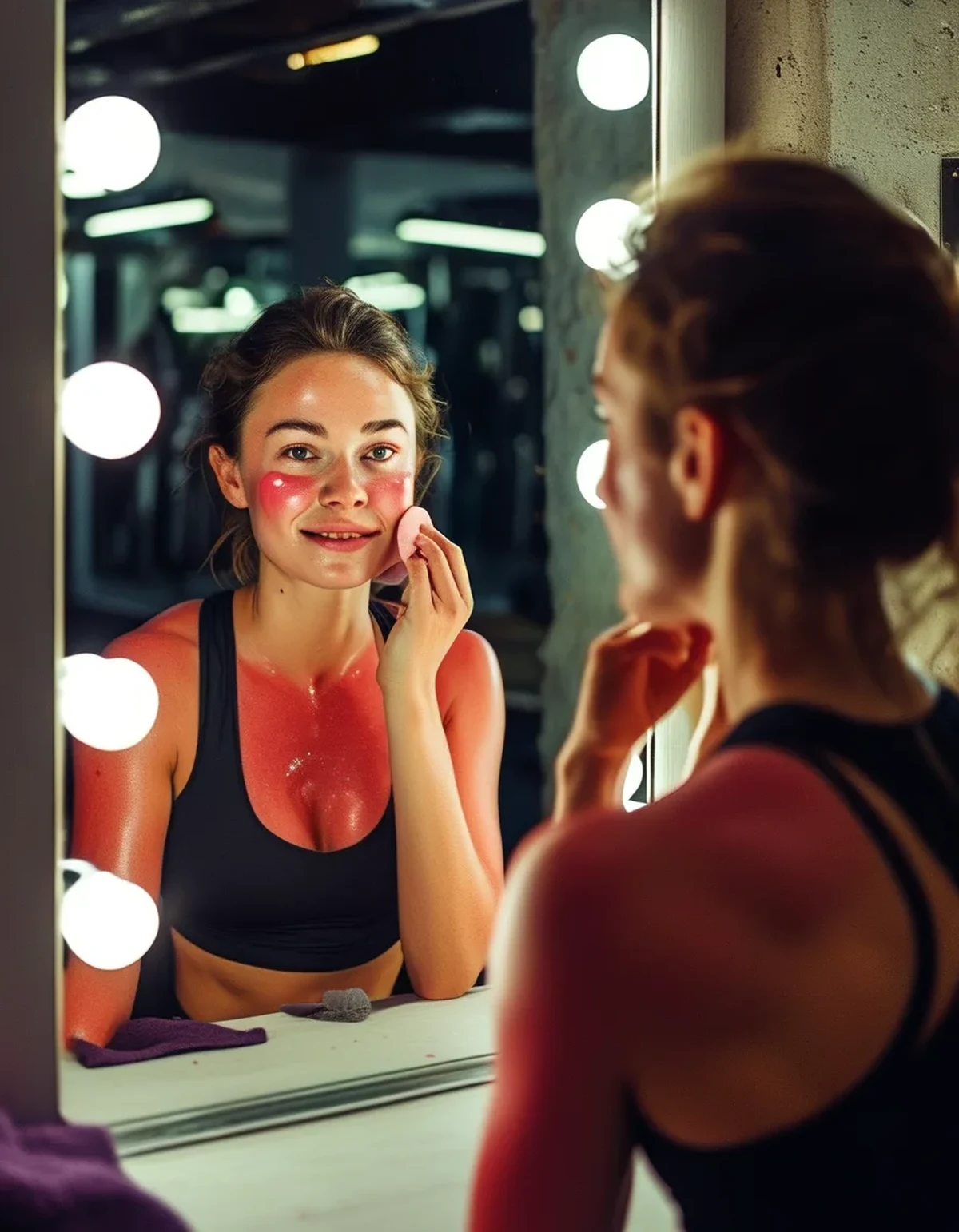
Sweat is an inside-out problem. It emerges from pores beneath your makeup, in volume, and it is not just water — it carries salts and lipids. It lifts product from underneath rather than degrading it from above, and once a channel opens, subsequent sweat follows it. This is why sweat failure is patchy and streaky rather than uniformly shiny.
Powder against sweat has a specific failure mode: the powder saturates, becomes a paste, and that paste then slides. Rather than absorbing the problem, it adds a layer that travels. Applied heavily enough, it also emphasises texture as it moves, which is where the cakey look comes from.
A useful diagnostic: if your face goes evenly shiny and your makeup slowly softens, that is humidity. If it stays matte in some places and disappears in stripes, that is sweat. They call for opposite responses.
What actually works against real sweat?
Adhesion and barrier, in that order, with as few layers as you can manage.
Start with grip, not moisture. A gripping primer — usually silicone or polymer based — gives products something to hold onto that is not skin oil. It matters more than any single product choice.
Use fewer, thinner layers. Every layer is another interface that can separate. A thin layer of long-wear product that has bonded properly to the skin survives far better than three light layers that have not.
Choose transfer-resistant over long-wear where you can. These are different claims. Long-wear resists breaking down over time; transfer-resistant resists being physically moved, which is what sweat and a towel do.
Let everything set properly before you sweat. This is the most commonly skipped step and among the most effective. Most long-wear formulas need several minutes to form their film, and applying makeup and immediately going into a warm-up gives you a product that never finished setting. Ten minutes before you start moving makes a visible difference.
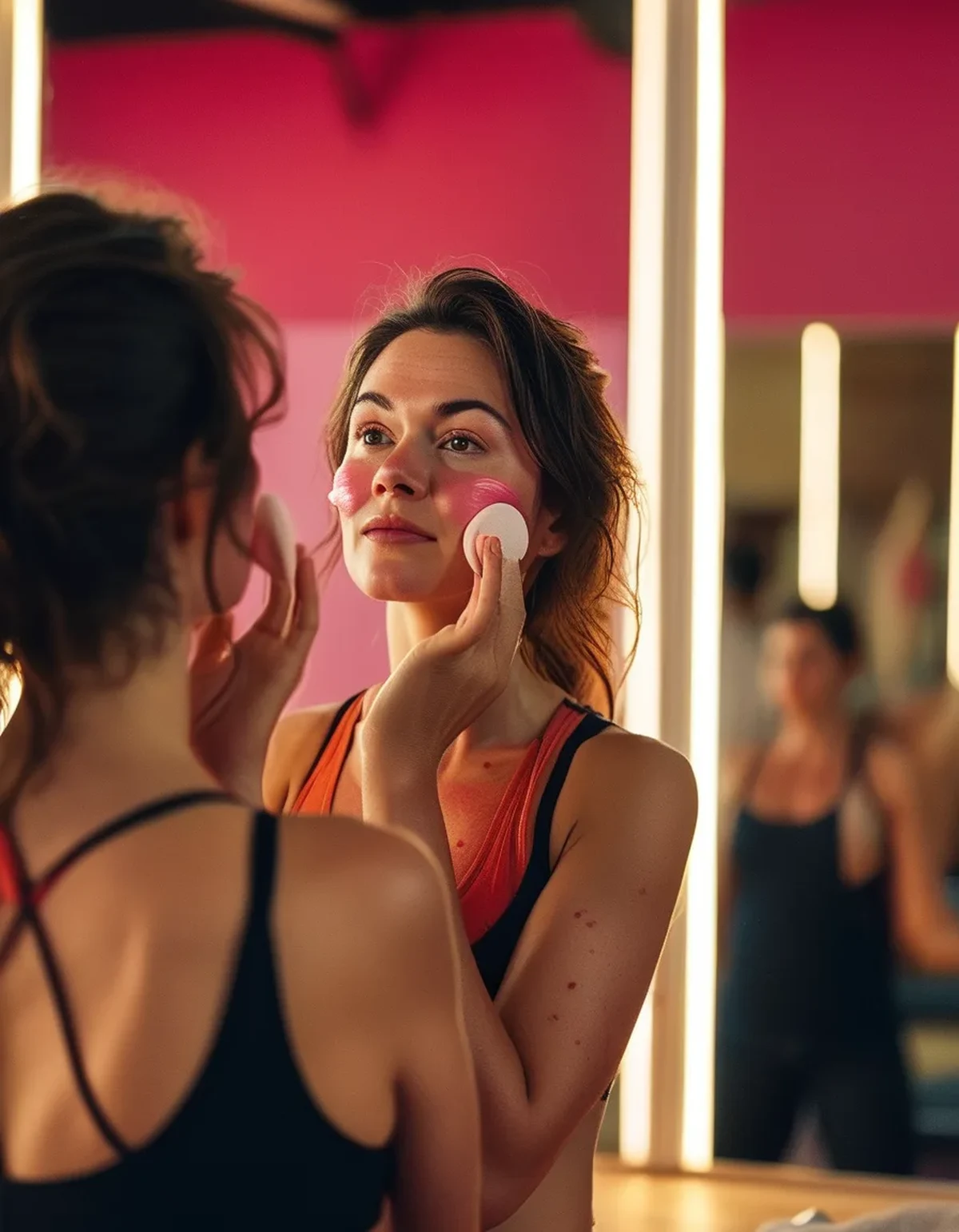
Set the specific zones that fail, not the whole face. A light dusting where sweat channels first — the T-zone, the hairline, and around the nose — targets the problem without turning the rest into a paste. Press it in with a puff rather than sweeping it; sweeping moves the base underneath it.
Waterproof only where it counts. Eye products are where transfer-resistant matters most, because migrating pigment near the eyes is both the most visible failure and the most irritating.
Myth vs Fact: Powder and Sweat
Myth: more powder means more staying power. Fact: past a thin layer, additional powder adds mass that has nowhere to go once wet. Heavy powder in a sweaty setting is one of the most reliable ways to get a streaky result rather than a matte one.
Myth: setting spray and setting powder do the same job. Fact: powder absorbs; setting spray forms a film that binds layers together. Against sweat, the film is the more useful mechanism. Against humidity and oil, absorption is. Using both, in the right order — powder first, spray last — covers more situations than doubling down on either.
Myth: waterproof means sweatproof. Fact: sweat contains salt and oils, and some waterproof formulations that shrug off pool water break down against sebum. This is why waterproof mascara can survive swimming and still smudge in a hot studio.
Myth: mattifying products prevent sweating. Fact: they manage oil, which is produced by sebaceous glands, and have essentially no effect on sweat, which comes from separate eccrine glands. A product can control shine perfectly and do nothing whatsoever about the sweat that will move your foundation.
Myth: skipping moisturiser helps it last. Fact: it usually makes things worse. Dehydrated skin produces more oil in compensation, and product applied to dry, flaking skin adheres unevenly and lifts in patches. A light, fully absorbed moisturiser gives a better base than none.
Myth: blotting papers and powder are interchangeable. Fact: blotting removes oil without adding anything, which is why it is the better mid-session tool. Powder mid-session adds a layer on top of existing sweat, and that is precisely the sandwich that slides.
How should you handle the seasonal switch?
Late summer into autumn is the trickiest window of the year, because you get both problems in one day.
The specific failure pattern: you apply for a humid morning, the temperature drops in the evening, and the product that was fighting humidity all day now sits on skin that has gone tight and dry. Makeup that was holding at 2pm looks patchy and emphasises texture at 7pm.
What helps is reducing the powder and increasing the flexibility of the base. As humidity falls week by week, the amount of powder that was correct in August becomes too much, and the same routine starts reading as dry and cakey rather than matte.
Change the sequence, not just the products. In humid conditions, powder does real work and belongs in the routine. In cool dry conditions, a gripping primer plus a thin flexible base plus a setting spray usually outperforms anything powder-based.
The gym-to-outside transition is its own problem. You finish a class hot and flushed, then step into cool air, and the temperature drop causes rapid changes in skin surface moisture. Anything that had gone slightly tacky sets in place, which is why makeup often looks worse ten minutes after a class than during it.
The practical answer for that specific case is to stop trying. A light, deliberately minimal routine for training — brows, a transfer-resistant lash product, tinted SPF, nothing else — survives the whole cycle and takes forty seconds. Full coverage that has to survive a workout, a shower and a commute is a problem with no good solution, and the products that come closest are the ones hardest on the skin.
If you are getting persistent breakouts along the hairline or jaw after workouts, that is more likely a cleansing-timing issue than a product one — sweat sitting under makeup for an hour post-session is the usual culprit, and rinsing promptly matters more than which foundation you chose.
FAQ: Powder and Sweat, Answered
Should I use powder at all for workouts?
A small amount in the T-zone before you start, pressed rather than swept, is worth it. Carrying powder to reapply mid-session is not — blotting papers do that job without adding a layer to something already wet.
Why does my makeup look worse after I cool down than during the workout?
Because the failure happens during the session and only becomes visible when the flush fades. Redness and dampness disguise patchiness while you are hot; once your skin returns to normal colour and dries, the streaks and bare patches are suddenly obvious. Nothing changed at that moment — you are just seeing what already happened.
Is there any product that genuinely handles both humidity and sweat?
A gripping primer plus a thin layer of a transfer-resistant base plus a film-forming setting spray is the closest combination, and it manages both mechanisms rather than one. It is still not a solution for a heated class or a hard cardio session, where the honest answer remains less product rather than better product.
TL;DR:
- Humidity is an outside-in surface problem powder solves; sweat is an inside-out volume problem powder makes worse.
- Diagnose by the failure pattern: even shine means humidity, streaks and bare patches mean sweat.
- Against sweat use grip primer, fewer thinner layers, transfer-resistant formulas, and 10 minutes of setting time before moving.
- Powder only in the zones that fail, pressed not swept; blot rather than re-powder mid-session.
- As autumn arrives, reduce powder and increase flexibility, or the same routine starts reading dry and cakey.
Most of the frustration here comes from applying a humidity solution to a sweat problem and concluding the products are useless. They are not — they were built for a different failure. Once you can tell which one you are looking at, the routine gets shorter rather than longer, and it works considerably better.
Keep Reading
This article is for general informational and styling purposes only. Fit, sizing, and product availability may vary.