Why Humidity, Not Sweat, Is What Breaks Your Makeup in August
Quick Answer: Sweat breaks makeup mechanically — liquid pushes product out of place and dilutes it. Humidity breaks makeup chemically and physically before you even sweat, by preventing products from setting, keeping films soft, and drawing moisture into powders. That is why makeup can slide on a humid day when you have barely moved. Sweat needs water resistance and setting; humidity needs lighter layers, longer set times, and less occlusion.
If your face fails before the workout starts, humidity is the culprit.

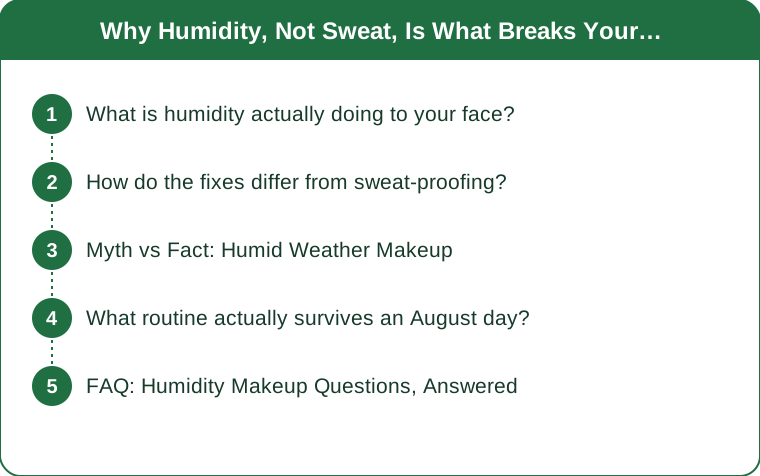
What is humidity actually doing to your face?
Slowing the drying that most makeup depends on, and softening what has already dried.
Most liquid makeup sets by evaporation. Foundations, primers, and setting sprays contain water or volatile solvents that leave the surface, and what remains is a film of pigment and polymer that resists movement. Evaporation drives the set, and evaporation depends on the difference in moisture between the film and the surrounding air.
When the air is close to saturated, that difference collapses. The product stays wet or tacky far longer, and some of it never fully sets at all. A film that has not set can be pushed around by the smallest movement, which is why makeup slides on a humid day without any obvious sweating.
Powders take on moisture from the air. Many setting powders and pressed products are mildly hygroscopic, which means they absorb ambient water. A powder that has absorbed moisture cakes and clings unevenly instead of sitting as a fine mattifying layer.
Your skin also produces more oil in heat. Sebum production rises with skin temperature, and humid heat keeps skin surface temperature elevated for longer. Oil is a solvent for many makeup films, so it breaks them down from underneath while humidity is preventing them from setting on top.
And then there is insensible perspiration — the constant, invisible moisture loss from skin that continues even when you are not sweating visibly. In humid air it does not evaporate, so it accumulates under your makeup.
Four mechanisms, none of which involve a workout.
How do the fixes differ from sweat-proofing?
Sweat calls for water-resistant films and firm setting. Humidity calls for less product, longer set time, and better sequencing.
Apply in thin layers and let each one set. This is the single most effective change. A thick layer in humid air has a wet centre under a dry skin, which is exactly the structure that slides. Two thin layers with a genuine pause between them behave completely differently.
Give the base far more time than usual. In dry conditions a foundation may set in a minute; in humid air the same product may need three to five. Do your eyes between base and setting, so the base has time to work while you are doing something else.
Use less product overall. Humid weather is where full coverage fails most visibly. A sheer base, spot concealing where you need it, and powder only where you get shine holds up far better than a uniform full-coverage layer.
Choose long-wear and transfer-resistant over water-resistant. Transfer-resistant formulas are designed to bind and resist movement, which is the failure mode humidity creates. Water-resistant is the property you want for sweat and swimming, and it is not the same thing.
Powder is not automatically the answer. Over-powdering in humidity leads to caking, because the powder absorbs ambient moisture and clumps. Use a small amount, pressed rather than swept, on the T-zone and around the nose.
Blot, do not add. When shine appears mid-day, blotting paper removes the oil that is dissolving your base. Adding more powder on top of oil creates the grey, cakey texture everyone recognises.
Skip heavy occlusive primers. Silicone-heavy grip primers can trap moisture underneath in humid conditions, which softens everything above them.

Myth vs Fact: Humid Weather Makeup
Myth: Setting spray fixes everything. Fact: Setting spray also has to dry. In humid air it evaporates slowly, and a heavy mist over a not-quite-set base can re-wet the layers underneath and make things worse. Use a light mist and give it real time.
Myth: More powder means more staying power. Fact: Powder absorbs ambient moisture and cakes. A small amount pressed into the areas that shine outperforms a full face swept over.
Myth: Waterproof and sweatproof mean the same thing. Fact: Water resistance is tested against immersion. Sweat is warm, salty, and continuous, and it arrives from underneath. Products can pass one and fail the other, which is why waterproof mascara can still smudge from sweat.
Myth: Primer always helps. Fact: The wrong primer in humidity is actively harmful. Heavy occlusive formulas trap moisture; grip primers designed for dry climates can go tacky and never set.
Myth: It is my skin type. Fact: Oily skin fails faster, and everyone fails in humidity. Dry skin types slide too, they just notice it as patchiness rather than shine.
Myth: Applying in the bathroom after a shower is fine. Fact: It is the most humid room in the house. Nothing sets properly in there. Move to a different room and the same routine performs better with no product changes.
What routine actually survives an August day?
Fewer steps, more time, and a small kit for the middle of the day.
Order that works in humidity:
Cool the skin first. Wash with cool water, or press a cold cloth for thirty seconds. Lower skin temperature slows oil production and gives your base a better surface to set on, and the effect lasts a surprisingly long time.
Lightweight moisturiser, fully absorbed. Wait two to three minutes. Applying base onto unabsorbed moisturiser guarantees sliding.
Skip or lighten primer, unless it is a mattifying one designed for oily conditions.
Sheer base, thin, in two layers if needed, with a genuine pause between. Build only where you need it.
Powder sparingly, pressed into the T-zone, using a small brush or sponge rather than a large fluffy one.
Cream products need extra caution in humidity — cream blush and bronzer stay movable much longer and are the products most likely to migrate. Powder versions are more reliable in August.
Light setting mist, from a distance, then leave it alone. Do not touch the face while it dries.
Mid-day kit: blotting papers, a small pressed powder, and a cotton bud. That handles ninety percent of what goes wrong.
The late season note: the humid period is not over. Late August into early September often brings the stickiest air of the year in much of the eastern and central United States, as warm ocean and high dew points persist while temperatures ease slightly. Comfortable air temperature with a high dew point is the worst combination for makeup, because it does not feel hot enough to prompt anyone to adjust their routine.
If your skin is reacting rather than just sliding — persistent redness, breakouts along the jaw, or irritation — that is worth a conversation with a dermatologist rather than a product change.
FAQ: Humidity Makeup Questions, Answered
Why does my makeup slide when I have not even been sweating?
Because humid air prevents products from setting properly. A film that has not fully dried moves with any contact, and insensible moisture from your skin cannot evaporate away, so it accumulates underneath.
Should I use setting powder or setting spray in humidity?
Both, sparingly. A small amount of powder pressed into the T-zone, then a light mist held at a distance and given real time to dry. Heavy application of either causes its own problems.
Is waterproof makeup better for humid weather?
Not necessarily. Look for long-wear and transfer-resistant claims, which target movement and friction. Waterproof targets immersion, which is a different failure.
Why does it fail worse on some days than others at the same temperature?
Dew point rather than temperature. A 26°C day with a high dew point is far harder on makeup than a 32°C dry day, because evaporation is what setting depends on.
TL;DR:
- Humidity stops makeup setting in the first place; sweat displaces makeup that has already set. Different problems.
- Thin layers, longer set times, less product, and pressed rather than swept powder solve the humidity version.
- Look for transfer-resistant rather than waterproof, and skip heavy occlusive primers.
- Late August often brings the year’s highest dew points, which is precisely when people stop adjusting.
Apply your base outside the bathroom tomorrow and give it three minutes before you touch it. That alone changes the day.
Keep Reading
This article is for general informational and styling purposes only. Fit, sizing, and product availability may vary.