Why Sweatproof Makeup Fails Differently in Cold Weather
Quick Answer: Cold weather changes the failure mode, not the fact of failure. Summer heat makes makeup slide; cold, dry air makes it crack, cling to flakes, and settle into fine lines, while you still sweat under layers. The fix is the opposite of your summer routine: less mattifying, more hydration under a flexible base, and cream formulas instead of powder.
You switched nothing. Same primer, same foundation, same setting spray that got you through August.
And now, forty minutes into a cold-morning run, your face looks patchy and dry rather than melted. The products did not stop working — the environment changed what failing looks like, and the fix for one failure makes the other one worse. The third section covers the layer people add in summer and forget to remove.
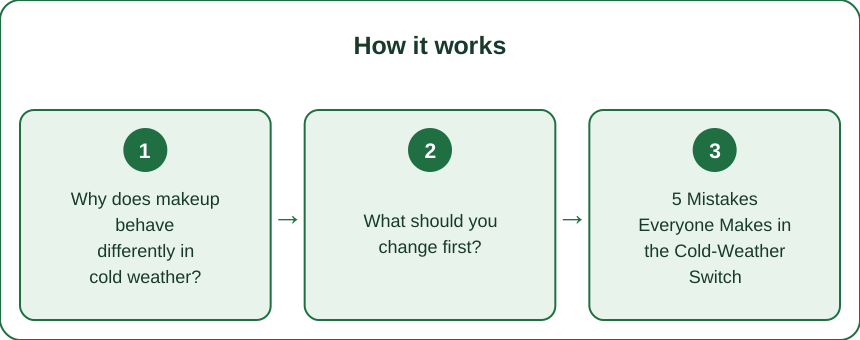
Why does makeup behave differently in cold weather?
Three environmental variables change at once, and they push in different directions.
Humidity drops sharply. Cold air holds far less moisture than warm air, and heated indoor air is drier still. Your skin loses water to the environment faster, and the surface becomes flakier. Makeup does not adhere to flaking skin — it adheres to the flakes, which then lift off, taking coverage with them in uneven patches.
Sebum production slows. Your skin produces less oil in cold weather. In summer, oil was the enemy that broke down your base from underneath. In autumn, its absence removes the flexible film that was helping product move with your face.
You still sweat, but in a confined space. Under a jacket, hat, and neck warmer, you sweat as much as ever — it just does not evaporate, because it is trapped against your skin. So you get the worst combination: a dry, tight face surface and damp trapped areas at the hairline, temples, and jaw where your layers sit.
The result is a split failure. The center of your face goes dry and patchy while the edges under fabric slip and transfer. A single mattifying strategy cannot address both, which is exactly why the summer routine fails.
What should you change first?
Work from the bottom of the routine up, because the base layer determines everything above it.
Exfoliate, gently and regularly. Not before a workout — two or three times a week, separate from training. You are removing the flakes that makeup would otherwise grab. A gentle chemical exfoliant is usually kinder here than a scrub, which can aggravate wind-chapped skin.
Add a hydrating layer under everything. A humectant serum with hyaluronic acid or glycerin on slightly damp skin, then a moisturizer to seal it. This is the single highest-value change, and it is the one people resist because they associate moisture with sliding. The sliding was oil, not water. Hydrated skin holds makeup better, not worse.
Downgrade your primer. A mattifying, silicone-heavy summer primer sitting on dry autumn skin creates a rigid film that cracks. Swap it for a hydrating or blurring primer, and use less than you did in July.
Switch from powder to cream. Cream blush, cream bronzer, cream highlight. Powder on dry skin emphasizes texture, catches on flakes, and looks chalky in the flat light of an overcast day. Cream formulas move with your skin.
Keep the base thin. A tinted moisturizer or skin tint will outperform full-coverage foundation in cold, dry conditions, because there is less product to crack. Spot-conceal where you actually want coverage rather than applying a uniform layer.
Set selectively, not overall. A light dusting only where your layers rub — hairline, temples, the strip under a hat brim — and nothing on your cheeks.
5 Mistakes Everyone Makes in the Cold-Weather Switch
1. Keeping the summer mattifying primer. It was the right tool for controlling oil that is no longer being produced at the same rate. On a dry face it is a layer of rigid film waiting to crack along every expression line. This is the leftover step almost everyone forgets to remove.
2. Setting the whole face with powder. In summer, an all-over set was defensible. In autumn it is the fastest route to a face that looks dusty and creased by the end of a workout. Powder only in friction zones.
3. Applying makeup immediately after a hot shower. The steam feels great and your skin looks plump for about four minutes. Then it dehydrates rapidly as that surface water evaporates, and it takes some of your skin’s own moisture with it. Wait, moisturize on damp skin, then apply.
4. Not adjusting for wind. Wind is the underrated variable. It strips moisture, chaps lips and cheeks, and makes your eyes water — which is what actually moves your eye makeup down your face on a cold run, not sweat. Waterproof formulas specifically resist tears, which is why they matter more in cold weather than in heat.
5. Skipping lip care and then wondering why lip color fails. Cold-weather lip color fails on flaking lips, full stop. No formula adheres to peeling skin. A balm at night and a gentle buff before applying anything fixes what looks like a product problem.
How should you handle the indoor-to-outdoor swing?
Autumn training means moving between a heated gym or car and cold outdoor air, sometimes repeatedly. Each transition is a stress on your makeup.
Going out: let your skincare fully absorb first. Applying makeup over tacky product and then walking into cold air sets it unevenly. Give each layer a minute.
Coming in: expect a flush and some slip. Vasodilation as you warm up brings blood and heat to the surface and can lift product at your cheeks. Blot rather than adding powder — powder onto flushed, slightly damp skin is what creates the cakey afternoon look.
For outdoor cardio specifically: minimize what you apply. Tinted SPF, waterproof mascara, a cream blush that will not go anywhere, and brow gel. UV is still meaningful in autumn even when it does not feel warm, and it is stronger than most people assume on bright, cold days.
If you train indoors and go out afterward, carry a small hydrating mist and a cream product rather than a powder compact. Reviving dry, worked-out skin needs moisture, not more layers on top.
One thing to leave alone: if you sweat heavily under a hat, do not try to fix the hairline mid-workout. Blot at the end, rehydrate, and reapply just there. Adding product to a damp hairline mid-session is how you get the visible line at the top of your forehead.
FAQ: Cold-Weather Workout Makeup Questions, Answered
Do I need setting spray in cold weather?
Yes, but a hydrating one rather than a matte-finish one. Matte sprays containing high alcohol content are drying, and on already-dehydrated autumn skin they accelerate the cracking you are trying to prevent.
Why does my foundation look grey or ashy in autumn?
Two likely reasons. Skin tone genuinely fades as summer sun exposure drops, so a shade matched in August is often too warm and too dark by October. And dry, flaking skin scatters light differently, which reads as dull. Reassess your shade seasonally.
Should I still use waterproof mascara if I am not sweating much?
Yes, and arguably more than in summer. Cold wind makes eyes water, and tears are what move mascara in autumn. Waterproof formulas are built to resist exactly that.
TL;DR:
- Cold, dry air changes the failure from sliding to cracking and flaking.
- Hydration under the base is the highest-value change, and the one people resist.
- Swap mattifying primer and all-over powder for hydrating primer and targeted setting.
- Cream formulas beat powder on dry skin; keep the base thin and spot-conceal.
- Wind and watering eyes, not sweat, are what move eye makeup in autumn.
The frustrating part of the seasonal switch is that nothing announces itself. Your products did not expire and your technique did not get worse — the air just started pulling moisture out of your skin instead of your skin pushing oil onto your makeup. Once you see it as a hydration problem rather than a longevity problem, the fix is mostly subtraction: less primer, less powder, less coverage, and one more layer of moisture underneath. Give it a week of your usual training and you will stop thinking about your face halfway through a run, which was the point all along.
Keep Reading
This article is for general informational and styling purposes only. Fit, sizing, and product availability may vary.